AI as a Systems Stress Test

Updated: Jul 24
Technology doesn't create organizational problems. It reveals the ones that already exist.
Organizations often describe AI as disruptive.
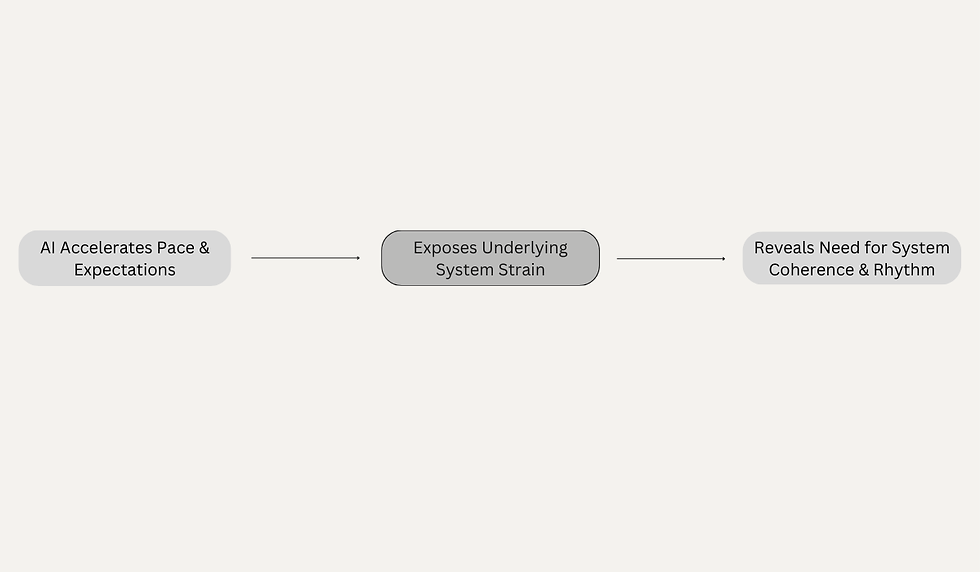
But AI rarely creates entirely new organizational problems. Instead, it accelerates existing patterns until they become impossible to ignore.
Misalignment becomes visible.
Capacity becomes constrained.
Decision bottlenecks become obvious.
Interdependencies surface.
The technology changes quickly, but what leaders experience is usually something much older.
AI acts as a stress test for the organizational system itself.
AI Doesn't Create Complexity
Every organization already operates through hundreds of interconnected decisions.
Strategy influences priorities.
Priorities influence operations.
Operations influence capacity.
Capacity influences customer experience.
Customer outcomes influence strategy.
These relationships exist whether AI is introduced or not.
What AI changes is the speed.
As decision cycles shorten, organizations have less time to compensate for fragmented planning, unclear ownership, or inconsistent priorities.
The weaknesses were always present.
Acceleration simply exposes them sooner.
AI Compresses Time
One of AI's greatest impacts is not intelligence.
It is compression.
Planning cycles shorten.
Information moves faster.
Expectations rise.
Leaders expect quicker decisions, faster execution, and shorter delivery timelines.
Organizations that lack stable operating rhythms begin experiencing:
competing priorities
rising rework
constant context switching
overloaded teams
inconsistent adoption
These symptoms are often blamed on AI.
More accurately, they reflect a system that cannot yet absorb the pace AI introduces.
This is why operating cadence becomes increasingly important. Stable planning rhythms create the capacity to absorb acceleration without creating organizational strain.
AI Reveals Interdependencies
Few organizational functions operate independently.
Finance depends on Operations.
Operations depend on Talent.
Talent depends on Strategy.
Technology depends on Governance.
Customer experience depends on all of them.
Under slower conditions, these dependencies can remain partially hidden.
AI shortens feedback loops.
When one function moves without another, the consequences appear much faster.
Organizations begin discovering:
unclear decision rights
conflicting assumptions
disconnected planning horizons
downstream impacts that were previously invisible
The technology is not creating these dependencies.
It is making them impossible to ignore.
AI Is a Tool, Not the System
Organizations sometimes speak about AI as though it were making decisions independently.
It isn't.
AI is a tool operating inside a human system.
Just as a nail gun helps a carpenter work more quickly, AI helps organizations process information more rapidly.
Neither determines what should be built.
That remains the responsibility of leadership.

The quality of organizational outcomes therefore depends less on the sophistication of the technology than on the quality of executive judgment guiding it.
A coherent organization becomes faster.
A fragmented organization becomes more fragmented.
AI amplifies both.
The Real Constraint Is Organizational Capacity
Many organizations are investing heavily in AI while underinvesting in the conditions required to absorb it.
Successful adoption depends on far more than technology.
It depends on:
clear governance
realistic prioritization
workforce capability
cross-functional alignment
sustainable operating rhythms
shared understanding of organizational intent
Technology scales rapidly.
Organizations do not.
Without sufficient integrative capacity, acceleration becomes strain rather than progress.
Integrative Leadership Matters More Than Ever
As AI becomes embedded in everyday work, organizations will need leaders who think beyond individual functions.
Someone must connect strategy with operations.
Finance with workforce planning.
Technology with organizational design.
Decision making with execution.
This work cannot be delegated entirely to technology.
It requires leaders capable of seeing the organization as an interconnected system.
That is where integrative leadership becomes essential.
Closing Reflection
AI is often described as a technological revolution.
In many organizations, it is something different.
It is a mirror.
It reveals how decisions are made, how information flows, how capacity is understood, and where organizational coherence quietly breaks down. The organizations that benefit most from AI will not necessarily be those with the newest tools. They will be those that have invested in clear intent, stable operating rhythms, cross-functional alignment, and leadership capable of understanding the system as a whole.
Technology accelerates.
Whether that acceleration produces coherence or fragmentation remains an organizational choice.
Related Reading
Organizational Maturity: Explores how organizations develop the capacity to absorb increasing complexity over time.
How Strategic Integrators Think: introduces the systems perspective required to recognize organizational patterns rather than isolated events.
What Is a Strategic Integrator: examines how integrative leadership helps organizations navigate complexity across functions.


Comments