Operating Cadence: Creating a Rhythm for Better Decisions

Updated: Jul 24
Organizations don't stay aligned by accident.
Priorities shift. Markets change. Capacity fluctuates. New information emerges.
Without a consistent rhythm for reviewing, recalibrating, and looking ahead, organizations gradually drift from strategy into reaction. An operating cadence provides that rhythm. Rather than treating planning as an annual exercise, it creates regular opportunities for leaders to understand what is changing, adjust course, and make decisions with shared context.
It becomes the mechanism that keeps strategy connected to execution over time.
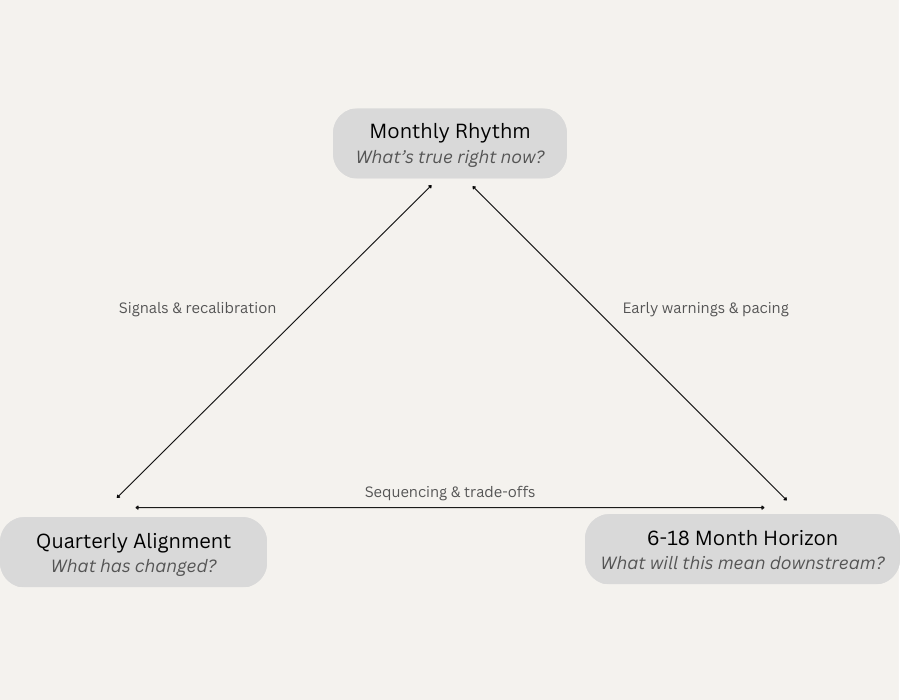
Three Connected Conversations
An effective operating cadence is built around three complementary perspectives. Each asks a different question. Together, they create a more complete picture of the organization.
Monthly Rhythm - What is true right now?
Monthly reviews anchor leadership discussions in current reality.
Rather than waiting for quarterly results, leaders review emerging signals across operations, finance, people, and customers while there is still time to respond.
The objective is not reporting. It is maintaining alignment with what the organization is actually experiencing.
Quarterly Alignment - What has changed?
Quarterly reviews create space to step back from day-to-day execution.
Leaders reassess priorities, revisit assumptions, and determine whether current commitments still fit the organization's capacity and strategic direction.
This is not about rewriting strategy every quarter. It is about ensuring strategy remains connected to reality.
The 6–18 Month Horizon - What will today's decisions mean downstream?
The medium-term horizon allows leaders to see implications before they become performance issues.
Capacity, investment decisions, workforce planning, customer demand, and operational constraints rarely change overnight. Viewing them together helps organizations recognize emerging trade-offs while meaningful adjustments are still possible.
This is where strategy becomes executable rather than aspirational.
Why the Three Horizons Matter Together
Each conversation answers a different question.
Monthly reviews explain today's reality.
Quarterly alignment connects that reality to strategic priorities.
The 6–18 month horizon explores where today's choices are leading.
None of these conversations is sufficient on its own. Together, they create a leadership rhythm that continuously links execution with longer-term intent.
What an Operating Cadence Enables
When organizations establish a consistent operating cadence, they become better able to:
identify emerging risks before they become crises
sequence priorities against real capacity
adjust plans without creating unnecessary disruption
maintain shared context across leadership teams
reduce reactive decision-making
Most importantly, the cadence creates predictability. Not because the future becomes certain, but because leaders revisit assumptions before they become problems.
Closing Reflection
Organizations often search for better decisions.
More often, they need better decision rhythms.
A well-designed operating cadence doesn't eliminate uncertainty. It creates a disciplined way of learning from the present, recalibrating the near future, and preparing for what comes next.
That rhythm is what allows organizations to remain coherent as conditions continue to change.
Related Reading
How Strategic Integrators Think: Explore why effective integrators naturally operate across multiple time horizons rather than focusing only on immediate execution.
Organizational Maturity Is More Than Growth : Understand how consistent operating rhythms become a hallmark of mature organizations.
What Is a Strategic Integrator: Learn how Strategic Integrators help leaders connect strategy, execution, and organizational capacity through structured decision-making.



Comments