How Decisions Ripple Through Organizations

Leaders often evaluate decisions by asking a simple question:
"Is this the right decision?"
It is an important question, but it is rarely sufficient.
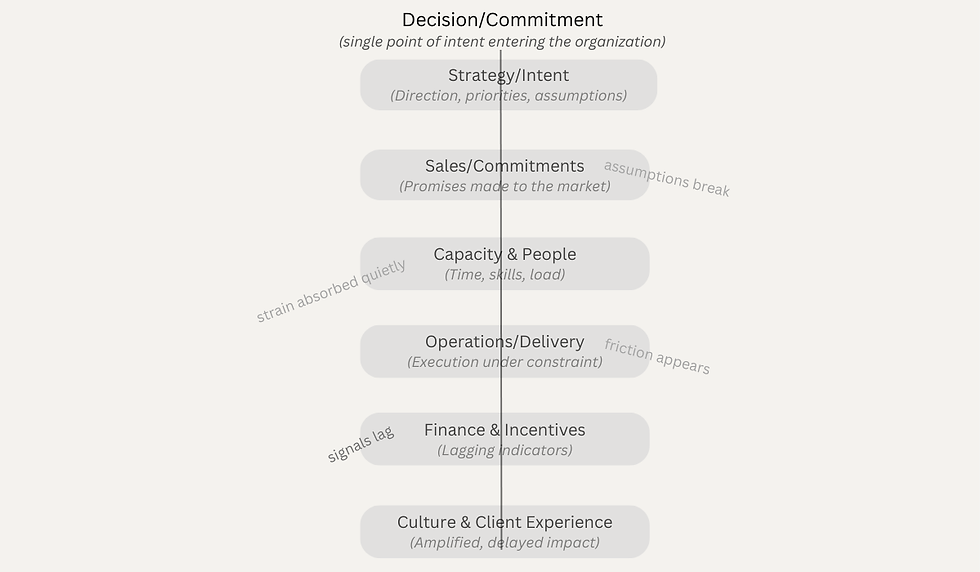
In organizations, decisions do not remain isolated. They move. They influence priorities, reshape workloads, alter incentives, affect relationships, and create consequences that often emerge far from the original decision itself.
A decision made within one function rarely remains within that function. Instead, it propagates through the organization, sometimes in predictable ways, and sometimes in ways that only become visible weeks or months later.
Understanding those ripples is one of the defining characteristics of effective executive leadership.
We Often Evaluate Decisions Too Narrowly
Organizations naturally assign ownership.
Finance owns budgets.
Operations owns delivery.
Human Resources owns people.
Technology owns systems.
Sales owns customers.
This specialization is necessary. However, it can unintentionally encourage leaders to evaluate decisions only within the boundaries of their own function.
A hiring freeze may appear to be a financial decision.
A product launch may appear to be a marketing decision.
An acquisition may appear to be a strategic decision.
In reality, none of these decisions belong to a single function. Each creates consequences that extend throughout the organization.
The decision itself may be local. Its effects are systemic.
Every Decision Changes the System
Consider a seemingly straightforward decision to accelerate a product launch. From one perspective, the decision creates an opportunity to capture market share sooner.
Yet that same decision also influences the organization's broader operating system.
Operations may need to compress implementation timelines.
Human Resources may need to accelerate recruitment.
Finance may need to revise investment assumptions.
Customer Support may experience increased demand.
Technology teams may inherit additional technical debt.
Managers may postpone capability development in order to meet immediate deadlines.
None of these consequences are inherently negative. The important observation is that they exist whether leaders intentionally consider them or not.
Every executive decision creates second- and third-order effects. Some strengthen the organization. Others gradually introduce strain.
Organizations Experience the Ripples, Not the Decision
One of the reasons organizational problems are often difficult to diagnose is that consequences rarely appear where decisions originate.
A customer complaint may be rooted in a staffing decision made months earlier.
Employee burnout may reflect years of accumulated prioritization choices rather than an unusually demanding project.
Financial underperformance may originate in operational constraints rather than market conditions.
Because effects emerge downstream, organizations often attempt to solve symptoms rather than causes.
Leaders respond to missed deadlines by increasing oversight.
They respond to declining engagement through communication initiatives.
They respond to quality concerns with additional process controls.
These interventions may address the visible problem while leaving the underlying pattern untouched.
The ripple continues.
The Strategic Integrator Perspective
Strategic Integrators approach decisions differently.
Rather than asking only whether a decision is correct, they ask how that decision will move through the organization.
Questions become:
Which functions will experience the greatest downstream impact?
What new dependencies will this create?
Where might unintended consequences emerge?
What capabilities will become more important?
Which assumptions will this decision challenge?
How will today's decision influence the decisions that follow?
This perspective changes leadership itself.
Decision-making becomes less about solving isolated problems and more about shaping the conditions under which future decisions will occur. In many cases, the quality of an executive decision is determined not only by its immediate outcome, but by the organizational environment it creates for everyone else.
Why Operating Cadence Matters
If decisions create ripples, organizations need mechanisms to observe them. This is one of the purposes of an operating cadence.
Recurring executive conversations allow leaders to reconnect decisions with their emerging consequences before those consequences become organizational failures. Rather than treating each meeting as an isolated review of current performance, operating cadence creates a continuous feedback loop.
Leaders revisit assumptions.
They observe downstream effects.
They identify unintended consequences.
They adjust course while there is still time.
In this way, organizations become more adaptive - not because they predict the future perfectly, but because they continuously learn from the consequences of their own decisions.
Reflection
Organizations are not simply collections of departments.
They are interconnected systems of decisions. Every executive decision influences the conditions under which countless future decisions will be made.
Some of those effects are immediate.
Many are delayed.
Some emerge in entirely different parts of the organization.
The question is not whether your decisions create ripples.
They always do.
The more important question is this:
What ripples is your organization creating today that you have not yet learned to see?
Related Reading
The Hidden Pattern Behind Organizational Failure: Learn how disconnected decisions gradually accumulate into organizational failure long before visible symptoms appear.
Operating Cadence: Discover how recurring executive conversations help leaders observe downstream consequences and adapt before small issues become systemic problems.
Organizational Maturity Is More Than Growth: Explore how increasingly mature organizations improve not by making more decisions, but by understanding how decisions interact across the system.



Comments